























![Dr. Zanita Kelly, Director of Lower and Middle School, pictured above, and the rest of Westridge Administration were instrumental to providing Westridge faculty and staff the support they needed after the Eaton fire. "[Teachers] are part of the community," said Dr. Kelly. "Just like our families and students."](https://westridgespyglass.org/wp-content/uploads/2025/03/dr.-kellyyy-1-e1748143600809.png)

![Lacrosse had an incredible season, making it to the semifinals. Jeff Searock, the father of player Sophie S. '28 has gone to most games and said, "[The season has] been great. Great coaching, great players, kids have great attitude. You can't ask for much more."](https://westridgespyglass.org/wp-content/uploads/2026/05/IMG_3652-1200x900.jpeg)














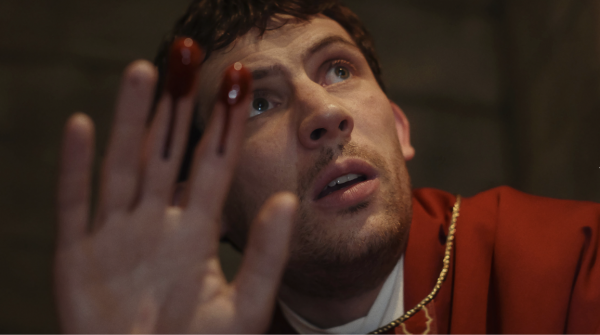
WUDM publicity stills
Warning: this review will contain partial spoilers of all three Knives Out films. Stay warned.
Once again, Daniel Craig has starred in a blockbuster film in the Knives Out universe. Once again, the film has raked in accolades from around the nation. So many things stayed the same from the first two installations in the series, yet in Wake Up Dead Man, the third film, the production team has outdone themselves: seeming to have finally found their footing—and produced a delightful, beautiful film.
As an unrelenting fan of the Knives Out series—one who has seen the first film more than a dozen times (and counting)—I retained hope for the third installment in the series, which was released in theatres on November 26, 2025, and on Netflix 16 days later. Despite my own disappointment—and that of fans alike—with the second film in the series, Glass Onion, the original film still has a place in my heart, and Wake Up Dead Man (WUDM) has only deepened my love for the series.
Part of my appreciation for this film comes from the bright, star-studded cast that seems to fit perfectly with their roles. With Josh O’Connor as an optimistic priest, Kerry Washington as a revengeful domestic lawyer, and even Josh Brolin as a rowdy, judgmental monsignor, WUDM feels as if the roles were written for the actors; the balance between personalities is enviable. Continuing on this note, WUDM also features my favorite up-and-coming actress, Cailee Spaeny, as a chronically ill religious skeptic, who I encourage you to keep an eye on, both in the film and in coming years—her portrayals, especially Simone in WUDM, feel so genuine and honest; something frankly scarce in a profession of performance.
Still, the moral conscience of the film is a dutiful Pastor Jud, played by Josh O’Connor who asks the audience to consider how the promise of riches destroys one’s morality. To me, this message stands out, not just for its relevance or truth, but for its simplicity. The first two movies in the Knives Out universe thrived on intricate premises—stories centered on a man who unnecessarily dies to save his beloved friend from certain imprisonment, while simultaneously destroying his greedy family’s prospect of a fortune and in the second, a wealthy entrepreneur committing a murder to save his empire built on the backs of supposed-best-friends-turned-adversaries (long winded I know). Yet in my opinion, this explanation-heavy style leaves something to be desired in the realm of cinematography.
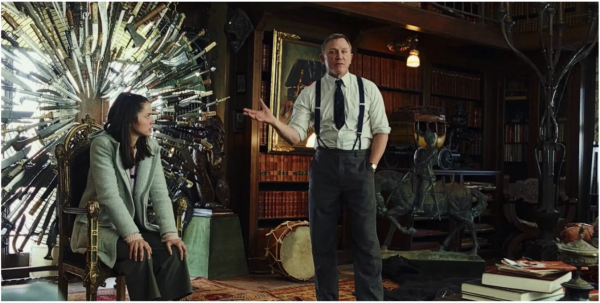
ScreenRant
Don’t get me wrong, I love the classic knife circle of the first Knives Out and the glass dome of Glass Onion, but thse felt like very singular one-off set pieces and locations. In comparison, the “Lazarus door” that could only be opened from the inside, the hidden tree trove, the cross-less church, and so many other pieces and places, WUDM felt ripe with meaningful and relevant images—giving me, the viewer, the chance to dive deeper into the presence of these pieces and their role in the story, instead of having to decode the story for myself, which was a peeve of mine in the second installment of the series. The first installment, however, relied on interviews to supplement relevant information—fully ignoring the “show, not tell” motto in filmmaking—which was successful to an extent, but deprived the film of establishing more unique imagery.
During this extra time that WUDM seems to procure, I was especially impressed by a 41-second strobe-lighting scene, perfectly paired with a heartbeat sound effect, showing Pastor Jud stabbing a character who was thought to be dead in an almost dream-like scene—a vision that is later revealed as such. In my first watch, I was amazed by this scene from the edge of my seat, and in subsequent viewings, I continue to be dazzled. This sub-one-minute scene truly has my heart, not just as a plot-obsessed Knives Out junkie, but as someone who can appreciate the beauty of lighting, sound, visuals, and plot standing hand in hand, which few movies seem to truly capture.
Throughout the film, this coexistence of elements is truly breathtaking. Dramatic echoes in the gothic church, long periods of silence in awkward misunderstandings, and light glistening behind Pastor Jud and in his handmade cross during moments of realization and resolution are examples of this phenomenon, but my verbal representation truly does not do the film justice—I wholeheartedly encourage you to watch it yourself.
I am genuinely excited to see what director Rian Johnson and his group of collaborators cook up next, but at the moment, I am extremely content with WUDM. Johnson has created such a beautiful film, and even better, one that is not boring (cough cough)—I look forward to my next dozen watches with so much delight.