



























![Dr. Zanita Kelly, Director of Lower and Middle School, pictured above, and the rest of Westridge Administration were instrumental to providing Westridge faculty and staff the support they needed after the Eaton fire. "[Teachers] are part of the community," said Dr. Kelly. "Just like our families and students."](https://westridgespyglass.org/wp-content/uploads/2025/03/dr.-kellyyy-1-e1748143600809.png)

![Lacrosse had an incredible season, making it to the semifinals. Jeff Searock, the father of player Sophie S. '28 has gone to most games and said, "[The season has] been great. Great coaching, great players, kids have great attitude. You can't ask for much more."](https://westridgespyglass.org/wp-content/uploads/2026/05/IMG_3652-1200x900.jpeg)

















“I only got four hours of sleep last night,” says one caffeine-indulgent student.
“Really? I only got three,” replies another, somehow more caffeine-indulgent student.
Any time I walk through the Westridge library, it’s almost guaranteed that I’ll hear something of this sort—where suffering becomes a rivalry.
It’s no surprise that Westridge is a competitive school. Between rigorous courses, contested leadership roles, as well as disputed—and incentivised—food drives, competition is a constant among students.
Still, as a Westridge lifer, the competition has never felt as overwhelming as it does now, in junior year. It could be due to my new responsibilities as an upperclassman, or the sudden emergence of the need to get into a top college, or any combination of the competition-driving factors affecting the youth today—but competitive suffering stands out to me as an emerging and particularly toxic form of this phenomenon, and one that is consistently harming my day-to-day life.
Mark Greenawald, a Virginia Tech Professor and Vice Chair of Family Medicine, believes competitive suffering happens when one assigns a “legitimizing score” to both their own and others’ sufferings.
This “legitimizing score” takes nuance out of one’s own suffering and forces them to decide if their suffering is esteemed more than that of others. This score also obliges competitive sufferers to justify their own suffering instead of just accepting their own feelings and reflecting, which is encouraged as a way to reduce stress and improve mental health.
This leads to a lack of compassion for either the self or others, depending on who is possessed by a greater misfortune. Susan Haworth of Cambios Coaching added to this theory, elaborating on how competitive suffering relies on a pain economy with a “limited supply of empathy.” This is what made me see the fault in competitive suffering. Empathy should never be limited.
This harmful way of thinking contradicts almost everything I’ve been taught by Human Development, administrators’ speeches, and teachers’ examples about acceptance and community-building at Westridge—and yet, so many students participate in this toxic behavior. From the conversations about lack of sleep that border on cutthroat to the omnipresent eating disorder culture and the overall sense of competition that is built into attending an exclusive prep school like Westridge, the idea that there is not enough empathy to go around feels incessant, and I’m surprised I haven’t recognized it sooner.
In my eight years here, I’ve always thought of Westridge as a welcoming and accepting place, and when I felt otherwise during periods of tumult or academic struggle, I blamed it on myself. In looking more deeply at the culture of competitive suffering that encompasses Westridge, I’m realizing that this blame wasn’t necessarily placed well.
Almost weekly, I hear people complain about their 93 percent test scores or that they just barely escaped the A- range, while I know full well that I got a B+. I have thought too many times to myself, if my friend is unhappy with their low-A grade, why am I happy with my B+?
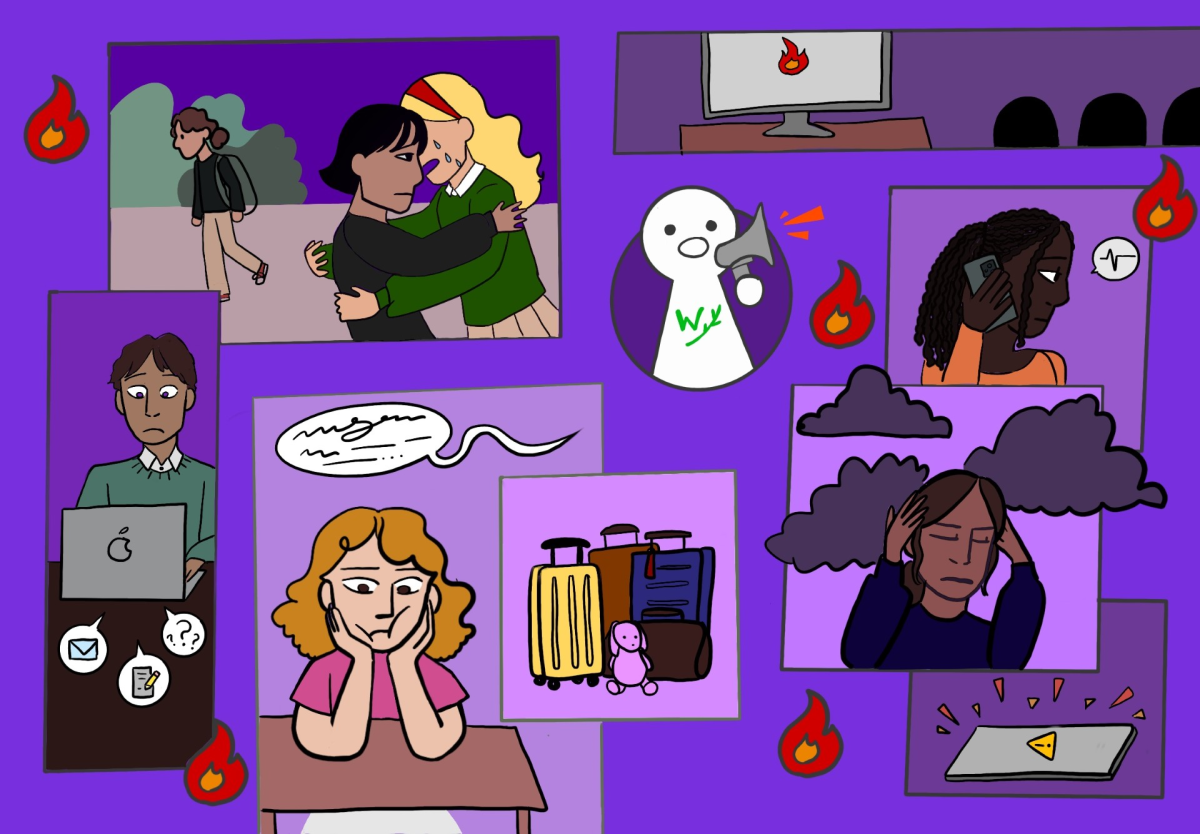
This is the problem with competitive suffering. Competitive suffering forces us to question both our own and others’ emotions and their worthiness—it tricks us into beating ourselves down for feeling certain ways. Too many times have I found myself trying to change my feelings towards a low grade, or a particularly bad night of sleep, or even an assignment that felt nearly impossible to me because of how other people portrayed their own experiences.
When boiled down, competitive suffering is really just judgment—judging yourself or others and putting someone down as a result.
This year, I’ve seen how this “legitimizing score” has forced itself into my life. When I hear of somebody having a hard day, I’ll try to mask my own depression and struggles for a kinder, more welcoming persona, because I believe their suffering and need for support supersedes my own.
This ritual oppression of my own emotions, as I have been realizing, means I seldom feel like I can come to Westridge as my whole self, lethargy and all. In talking to classmates about this culture I’ve been contributing to, I’ve found that I am not alone in this realization.
One of my friends described the culture of competitive suffering as an “oppression olympics,” with the deepest sufferers being praised the most for their undertakings. She also mentioned hearing statements like “my class has more work” and “my teacher is harder” frequently in casual conversation.
And even on the flip side, where individuals dismiss their own pain because they think that things could be worse, competitive suffering still succeeds in putting people down.
Even though I feel like I don’t fully understand how competitive suffering impacts me, I am working to improve my relationship with this phenomenon, and I think you should as well.
And this isn’t to say that all competition is harmful—I love comparing my progress to that of past years and Westridge’s sports teams to those of other schools. But when competition becomes an overwhelming negative, one that makes me question the validity of my feelings, I can tell it’s going too far.
Katie Hurley, adolescent psychotherapist, wrote for USA Today that “When competition turns toxic…kids suffer.” This statement resonates with me. In leaning into the “pain economy” of competitive suffering, one adopts the belief that one’s struggles are not subjective but deeply impersonal and disconnected from oneself.
When one separates themselves from their struggles and pushes them down under the guise of altruism, nobody wins—not the person pushing their suffering to the back of their mind, or the one being treated with half-selfless care, or the bystanders that have to watch this trainwreck of a performative support system.
Still, the only way to move through this flawed system at Westridge is by identifying it.
The first step—that I have found—is recognizing that you, too, are affected by the culture around competitive suffering. Whether you’re the one loudly comparing your sleep schedule to others’ or silently comparing your portion size with those of your friends during lunch, competitive suffering may affect you in ways that are either cognizant or unconscious. If you can recognize yourself feeling impacted by this phenomenon, try to remember that suffering is subjective—there should not be value placed on suffering, let alone an economy based on it.
One of the ways I’ve tried to minimize the impact of competitive suffering on my life is by reaching out to others and being more open about my feelings. While asking for help may seem difficult, and I’m not denying that it is, Westridge’s culture of competitive suffering has instilled in me a belief that persevering is the norm—and that asking for help is shameful.
This year especially, I have called on my friends, advisor, teachers, and almost all others in my life more than ever before, and my world has not yet ended due to shame. I have reached almost my breaking point with academic and non-academic situations piling up, and I hate to think that the reason I waited so long to ask for help was because I thought, I can do it myself. I know others deal with more.
All this being said, the culture of competitive suffering at Westridge needs to go. It’s not healthy to suppress your feelings, and it’s incredibly toxic to do to others. I’m trying not to participate in this culture of judgment because I can tell it’s hurting me, and I encourage you to do the same if you notice a negative impact on yourself.